
'The implementation of the judgment has largely been left to the discretion of the very executive authorities it sought to restrain.'

The execution of Nimisha Priya, an Indian nurse on death row in Yemen, has been postponed by Yemeni authorities, sources said on Tuesday.

It also aims to reduce the powers of the Supreme Court, with some authorities shifted to the proposed Constitutional Court, and immunity to the president from criminal proceedings for life.

Private schools failing to provide these facilities risk de-recognition

Maharashtra is set to hold local body elections for municipal councils and nagar panchayats, marking the first phase of a Supreme Court-mandated process. The elections are seen as a key indicator of political sentiment following the BJP-led Mahayuti's victory in the assembly elections.
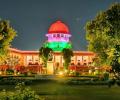
The Centre has told the Supreme Court that imposing fixed timelines on governors and the president to act on bills passed by a state Assembly would amount to one organ of the government assuming powers not vested in it by the Constitution and lead to a "constitutional disorder".

The Supreme Court has addressed the issue of reservation quotas in Maharashtra local body elections, stating that the final results of elections in 57 local bodies, where the 50% quota ceiling has been breached, will depend on its judgment in the case.
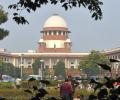
A Constitution bench comprising Chief Justice B R Gavai and Justices Surya Kant, Vikram Nath, P S Narasimha and A S Chandurkar, would fix the timelines on July 29 and commence hearing on the presidential reference in mid-August.
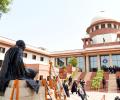
Calling itself the "custodian of the Constitution", the Supreme Court on Thursday asked if it could "sit idle" if a constitutional functionary like governor failed to discharge duties, as it reserved its verdict on the presidential reference on grant of assent to bills.
The Supreme Court has scheduled hearings starting August 19 for the Presidential Reference concerning constitutional issues related to timelines for handling bills passed by state assemblies. The court has directed the Centre and states to submit written arguments by August 12.

The Supreme Court is scheduled to pronounce interim orders on key issues related to the Waqf (Amendment) Act, 2025, including the power to denotify waqf properties.

'We are not all Abduls, you know. Our community has any number of retired civil and defence officers, doctors, engineers, lawyers.'
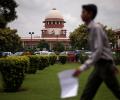
The Supreme Court is scheduled to pronounce interim orders on key issues related to the Waqf (Amendment) Act, 2025, including the power to denotify properties declared as waqf.
The Supreme Court is hearing arguments regarding a presidential reference on whether fixed timelines can be imposed on governors and the president for acting on bills passed by state legislatures. The court is considering objections to the maintainability of the reference under Article 143 of the Constitution.

'You know the situation in Yemen now. There is no government there.' 'The rebels are in control. So, there is no diplomatic channel through which we can negotiate.'
The Supreme Court of India has cautioned against the dangers of unregulated social media, emphasizing that freedom of speech cannot be exercised at the expense of others' dignity and integrity. The court was addressing a plea related to a recent incident where a shoe was thrown at the Chief Justice of India.
The Centre told the Supreme Court that governors are not indefinitely sitting on bills passed by state legislatures, and that barring a few exceptions, most have acted in a way which the apex court would have perhaps desired. Solicitor General Tushar Mehta argued that a Governor is "not a rubber stamp" and has a duty to preserve, protect, and defend the Constitution.

BJP-ruled states argued in the Supreme Court that governors and the President have autonomy in assenting to bills passed by state assemblies, asserting that courts cannot mandate assent.

Vijay, despite the loud message from his delayed arrival at the road-show/stampede venue, and more so his continued inaccessibility for fans-turned-cadres after graduating from a super-star to a political party leader with electoral ambitions, refuses to change. Or, so it seems, observes N Sathiya Moorthy.

The Deepa Thoon controversy, if not allowed to die a natural death, could take the election focus away from the anti-incumbency impacting the DMK and into the secular space. Stalin would love to have it that way, all over again, after the three past elections, points out N Sathiya Moorthy.

A profile of B Sudershan Reddy, former Supreme Court judge and Opposition's vice presidential candidate, highlighting his career, judgments, and contributions to constitutional law.

President Droupadi Murmu has exercised powers under Article 143(1) used in rarity to know from the Supreme Court whether timelines could be imposed by judicial orders for exercise of discretion by President while dealing with the bills passed by state assemblies.

The sequence of events since Pakistan's Chief Justice Iftikhar Mohammed Chaudhry was suspended on March 9, which sparked a major crisis in the country.

The Supreme Court on Thursday refused to examine a public interest litigation (PIL) seeking a judicial probe into the April 22 Pahalgam terror attack in which 26 people were killed.
Prime Minister Aziz told reporters that the government had no plans to the withdraw the reference against Chaudhry containing allegations of misconduct and misuse of authority, which the SJC would take up on April 3.
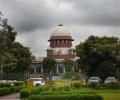
A five-judge Constitution bench of the Supreme Court is scheduled to consider the Presidential reference on whether timelines could be imposed by judicial orders for the exercise of discretion by the President while dealing with bills passed by state assemblies.
A petition filed by one Shahid Orakzai questioned the "relegation" of a Muslim chief justice and the appointment of a non-Muslim judge to the post.
The Supreme Court has initiated a suo motu case regarding investigation agencies summoning lawyers and will examine if they can be put to notice. The action follows the Enforcement Directorate summoning senior lawyers, which was condemned by bar associations.

The matter would be heard by Chief Justice B R Gavai and Justice Augustine George Masih.

The Supreme Court expressed its disapproval of an analogy used by the Centre in support of the inclusion of non-Muslims in Waqf boards, stating that such logic would disqualify a bench of Hindu judges from hearing matters related to Waqf. The CJI questioned the Centre's stance on the provisions of the Waqf (Amendment) Act, 2025, which allows non-Muslim members in the Central Waqf Council and state waqf boards. The Solicitor General defended the provisions, emphasizing that the non-Muslim inclusion is limited and does not impact the Muslim composition of these bodies. However, the CJI asserted that judges shed their religious affiliations while serving on the bench and maintained their secularity in their judicial capacity.
The Tamil Nadu government has urged the Supreme Court to dismiss the Presidential reference concerning the Governor's powers to assent to bills, arguing it is an 'appeal in disguise' to overturn settled law.
The Supreme Court of India has ruled that governors cannot indefinitely delay giving assent to bills passed by state legislatures, setting a timeline of one to three months for their actions. The court said the governor must act "as soon as possible" and that failure to comply with the timeline will make their inaction subject to judicial review. The ruling comes as several opposition-ruled states have accused governors of delaying assent to bills passed by their assemblies.
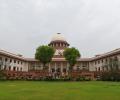
The Indian government has defended the Waqf (Amendment) Act, 2025 in the Supreme Court, arguing that there cannot be a blanket stay on the law as there is a presumption of its constitutionality. The Centre countered the pleas challenging the law's validity, asserting that the amendments were undertaken after a comprehensive study by a parliamentary panel. The government also highlighted the "reported misuse" of earlier provisions and the increase in waqf land, claiming that over 20 lakh hectares were added after 2013.

The Supreme Court has questioned the practice of Governors withholding assent to bills indefinitely, stating that it renders the constitutional provision of 'as soon as possible' meaningless.
The Supreme Court on Monday said the pleas challenging the Waqf (Amendment) Act's constitutional validity will now be taken up by a bench headed by Chief Justice of India-designate Justice B R Gavai on May 15 as the incumbent CJI will be demitting office on May 13.

Some of his directives had the Supreme Court judges disclose their assets whereas the row over the discovery of cash from a sitting judge's official residence paved way for inquiry.
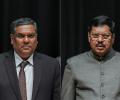
From demonetisation to sub-categorisation of Scheduled Castes to bulldozers, Justice Gavai has been part of several judgments.
The Supreme Court of India began hearing a batch of petitions challenging the constitutional validity of the Waqf (Amendment) Act, 2025. The bench, led by Chief Justice Sanjiv Khanna, asked both sides to address whether the court should entertain the petitions or relegate them to the high court. The hearing is underway with senior advocate Kapil Sibal arguing for the petitioners. The act, which was passed by Parliament following heated debates, has been challenged by various parties including AIMIM leader Asaduddin Owaisi, All India Muslim Personal Law Board (AIMPLB), and Jamiat Ulama-i-Hind.
A Governor does not possess any discretion in exercise of functions under Article 200 of the Constitution in respect to any bill presented to them and must mandatorily abide by the advice tendered by the council of ministers, the Supreme Court has held.

Underscoring the 'presumption of constitutionality in favour of law', the Supreme Court on Tuesday said petitioners challenging the waqf law needed a 'strong and glaring' case for interim relief.
